
Set the scope. Find out when it ships.
Pick any backlog, epic, or release in Jira. See when you'll actually ship — grounded in your team's real delivery history.

You've been burned before.
The team gave a date in good faith. Then sprint after sprint of slippage made the roadmap meaningless.
Leadership stopped trusting the timeline. You stopped sharing one.
Every date you give is a guess.
The credibility gap widens with every missed date — and so does the gap between what your team can actually deliver and what stakeholders think they should.
A date you can defend isn't about being right every time. It's about showing the math, so the conversation moves from "is the team underdelivering?" to "how should we adjust?"
Same data. Sharper question.
Your team's delivery history sets the date — not anyone's gut. The forecast samples your real history forward. The number reflects how you actually ship — not how someone hopes you will.
Two methods, picked by your data. The engine samples either your team's cycle times by bucket (Plan A) or your sprint throughput (Plan B) — whichever runs tighter. It tells you which it picked and why.
Works with what you already track. Whether your team plans in story points, runs on throughput, or both — the forecast uses your existing data. No new instrumentation, no new ceremonies.
The buckets are doing the work.
By work type, cycle-time CV across our last 25 issues is 100% — unpredictable. By story-point buckets (0.5pt, 1pt, 2pt), the same 25 drop to 26% — highly predictable.
Sprint throughput across our last 11 sprints is also high (54–70% CV). Throughput-based forecasting alone would call us unforecastable.
The buckets are doing the work. They tell us which sizes we forecast tight on — and which oversized items to break down to tighten the rest.
Four steps to a forecast that holds up.
1. Set the scope. Use any JQL query, an epic, a release, a milestone — whatever scope you care about.
2. Don't worry about unestimated work. The forecast runs on your team's delivery history. Start now with what you have — estimation never blocks the forecast.
3. See your finish dates. Likely, plan-for, and worst-case — with the confidence math behind each one, so the number is yours to defend.
4. Track and steer as you ship. Watch the forecast move and see what's pushing it — scope, incidents, side work — so you can act early.
One screen, three things working together.
The selection — your chosen issues with cycle-time history per bucket, so you see at a glance which items are widening the forecast.
Noesis sidebar — your AI coach: picks the forecasting method your data supports, names what could break it, flags which buckets are widening the forecast, and catches whatever's pulling the date as the team ships.
The forecast — likely / plan-for / worst-case dates, grounded in your team's history. Save it as the baseline to track and steer against.
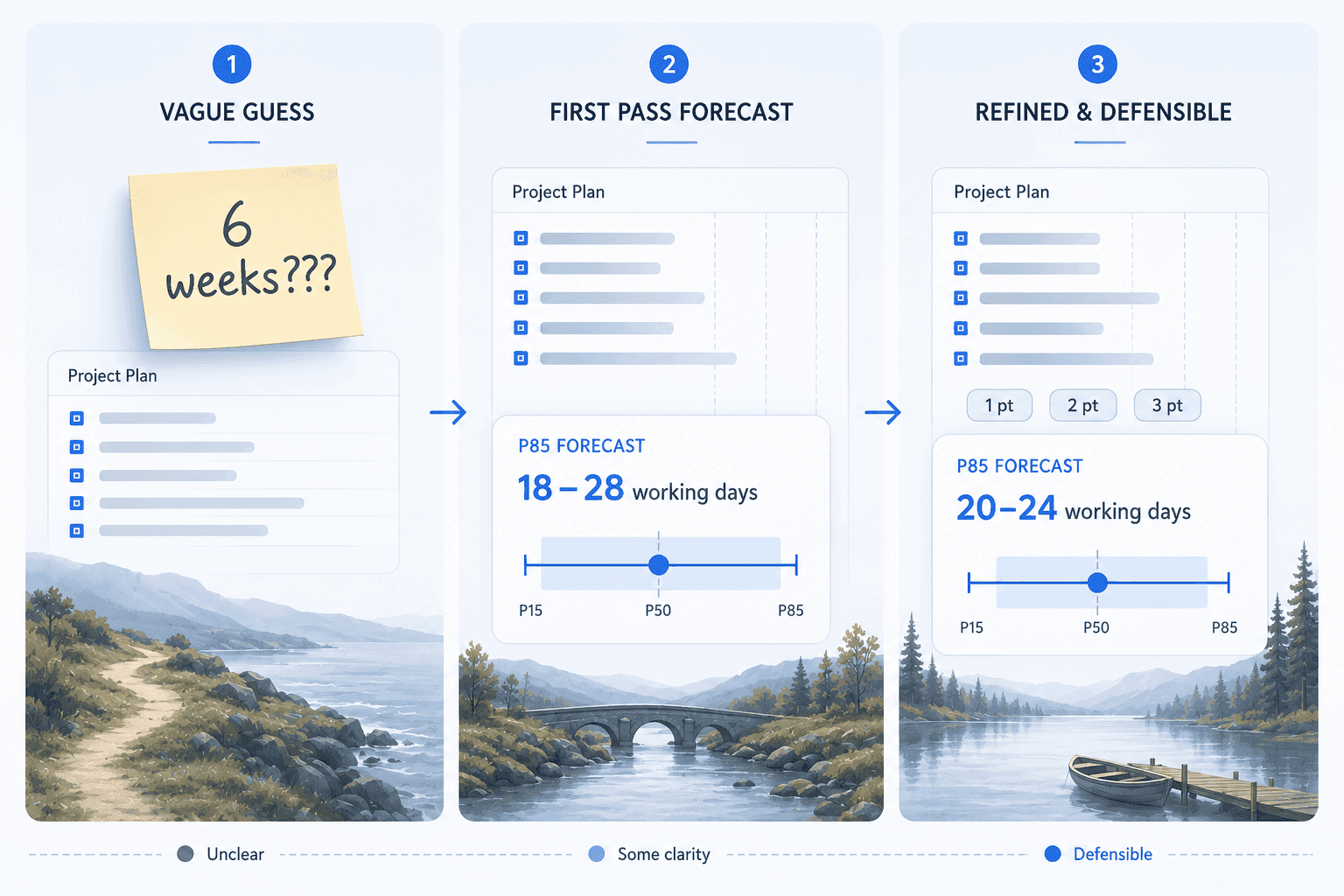
From hedged dates to forecasts you can defend.
You walk in with a range, not a number to be negotiated down from. "18–28 working days at 85%, for the 18 stories in this epic." Not "about three weeks." A range with the confidence math behind it.
You walk in with the assumptions visible. What the forecast is built on — your team's recent delivery, what's driving the range — is on the screen. When someone questions the number, the answer is right there.
You walk in able to attribute the variance. "Forecast widening by +5 days — 4 production incidents consumed 2 days of capacity, plus 2 items added to scope." You see exactly what's pushing the date — with the data to push back.
Honest about when it won't work.
You need a few sprints of delivery history and work that's broadly repeatable — items that resemble each other often enough to learn from. Most product teams qualify. Agency work split across separate clients with no shared deliverable usually doesn't.
When the data isn't there, Smart Guess will say so.
We'd rather refuse a forecast than hand you a confident-looking number we can't back.
Early access opens in weeks.
Get on the list now — early teams shape what we build first and use it free.
