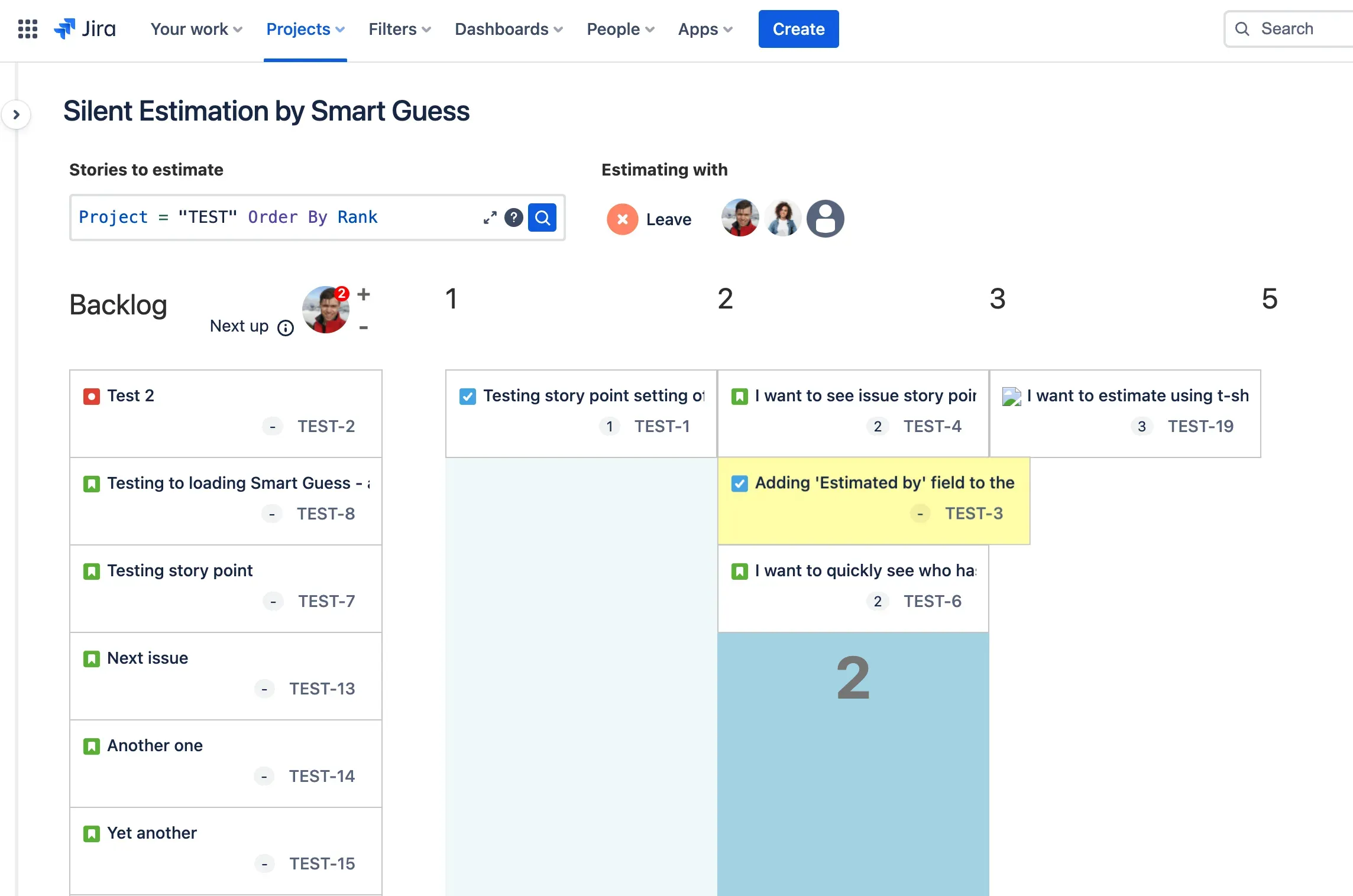
Silent Grouping in Jira: A Faster Approach to Estimating Large Backlogs
The Silent Grouping method, also known as Bucket System Estimation, was introduced by Ken Power in 2011. It is designed to minimize unnecessary discussion users often get bogged down with when using the Planning Poker method to estimate user stories. It complements Planning Poker perfectly; now, both methods are available from Smart Guess.
Key value of Silent Grouping
1. Increases Efficiency:
- Speeds up the estimation process by eliminating lengthy debates or discussions before initial estimates are provided.
- Focuses discussions on discrepancies or significant variances after the silent phase.
2. Reduces Bias and Groupthink:
- Ensures that individual estimations are not swayed by the opinions or confidence of more vocal team members.
- Encourages independent thought, which often results in more accurate and diverse estimates.
3. Fosters Inclusivity:
- Provides a platform for quieter or less confident team members to contribute their perspectives without being overshadowed by louder voices.
4. Enhances Accuracy:
- Leverages a diverse set of individual insights to arrive at a more balanced and well-informed collective estimate.
- Highlights outliers and fosters meaningful conversations where estimates diverge significantly.
5. Encourages Critical Thinking:
- Team members must rely on their own understanding and analysis rather than deferring to others, promoting a deeper engagement with the task at hand.
When to use Silent Grouping?
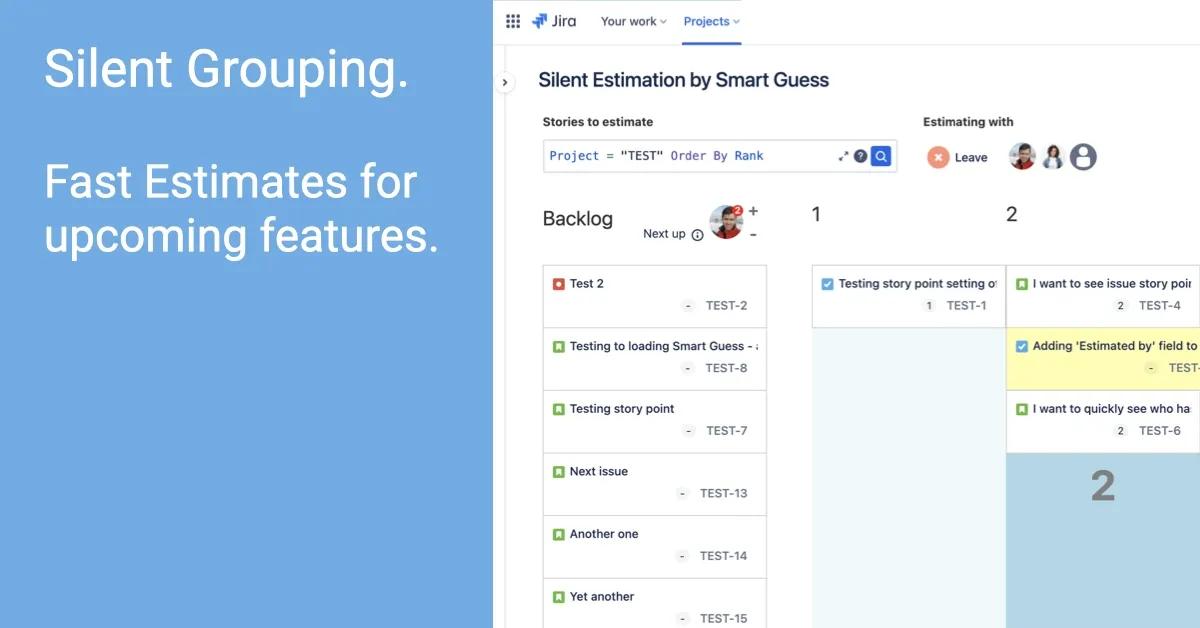
When teams start a new project or a large feature, estimating many stories using Planning Poker takes time. It takes time because teams often end up in a detailed discussion for each story, which is perfect when development is about to start but is not needed for large stories that will be broken down at later stage.
With Silent Grouping, teams naturally focus on the relative size of each story compared to others rather than diving into details for one story, leaving detailed discussions for later. This allows teams to move considerably faster, perfect for long-term planning.
When to use Planning Poker?
With Planning Poker, the discussions that take place are ideal for assessing what to implement during upcoming sprints. Because before starting work on a user story, a common understanding of what you plan on having ready when you finish the sprint is essential. For this reason, you must discuss and decide how to implement the user story and how much time to invest. There are always tradeoffs where the team and, ultimately, the product manager need to weigh the value vs. the cost of different implementation options, such as:
- Simple and quick - 2 story points
- Better, yet not perfect - 5 story points
- Fancy pansy - 20 story points
The Planning Poker method clarifies how much effort the product manager is willing to invest relative to everything the team can spend their time on. So many teams use Planning Poker during refinement meetings to clarify what to build during the upcoming sprint(s).
Balancing how deep your story discussion goes
So it’s a balancing act of how deep you go with each story discussion. Stories you will soon start working on are smaller and need more clarity and a deeper discussion. Planning Poker is the perfect tool for this case.
However, for stories further away on the backlog that will be further broken down later, focus the discussion on what you know today and note down key areas of uncertainty to clarify. Bucket Estimation is perfect for this case.
How to run your first Silent Grouping meeting with your team?
Here is how you run your first Silent Grouping meeting:
0. Preparation
Ask your team members to review the stories before the meeting. This will save time, compared to if only some have reviewed while others have not. Furthermore, allow participants to ask questions when the meeting starts and clarify any questions before starting.
1. Lay the ground rules
Review the following with your team:
- What is a relative estimate (if needed)
- Decide who will go first, second, etc.
- Decide on how many stories each team member will estimate / each turn
- Clarify steps #2,# 3, and #4 below (or share this post with your team)
- Important: keep the estimation session Silent, or mostly silent (see variations below), during steps #2 and #3 below
When team members disagree on a story placement
- consider why your colleague might think the story belongs there, before moving it to the '?'-column for further discussion.
2. Individual Placement
Goal: Quickly get an initial estimate for all user stories Take turns, one at a time, place stories on the board, and get an initial assessment of the story size.
3. Group placement
Goal: Allow everyone to (silently) provide input to initial estimates and get to a consensus on the size of the stories
Take turns in moving stories you find still need to be correctly sized. Team members might move the same story repeatedly, i.e., one moves a story from 13 to 20, and another moves it back to 13. In these cases, remind the team to consider why your colleague moved the story. Observing and thinking through why the user story moved is often enough to resolve the disagreement. When nobody is prepared to compromise, place the story in the '?' column for further discussion.
4. Discussion and reflection
Goal: Resolve any disputes that occurred during step 3. Reflect on the experience; gain consensus before moving on.
Go through the stories in the '?-column' and clarify why team members couldn't agree silently. You can use the planning poker method for these cases.
Variations
Have just one round Instead of having Individual placement, then Group placement, allow team members to move any story. Sometimes, the focus moves early to a few user stories where there is disagreement. For this reason, keep these steps separate to prevent this.
Allow little talking A quick and quietly whispered conversation can often resolve disagreements and clear misunderstandings. However, it is a slippery slope. The facilitator needs to be aware of the effects of this and the example it sets for the rest of the team. It requires careful balance and awareness of the different forces at play in the room.
Enhance Your Agile Estimation with Smart Guess Pro
Incorporating efficient estimation techniques like Silent Grouping will help improve your Agile team’s productivity. Smart Guess Pro offers both Silent Estimation and Planning Poker. These solutions are designed to simplify backlog refinement and improve estimation accuracy within Jira. Explore how Smart Guess Pro can transform your team’s workflow and lead to more effective sprint planning.
